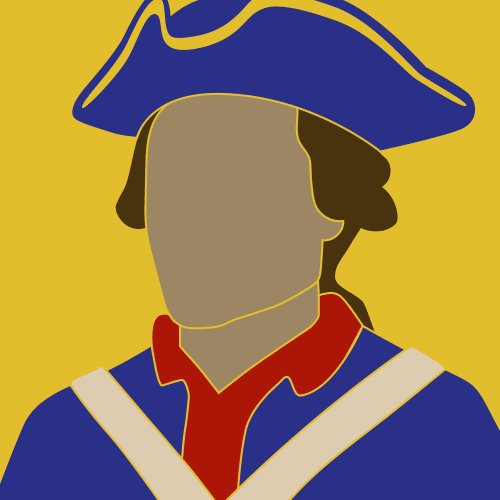
I represent Francis Kearney. I was born at Perth Amboy, New Jersey in 1752, but left there in 1774 as revolutionary violence began to heat up. I was appointed a captain in the Provincial Corps of Pennsylvania Loyalists raised in 1777. The corps arrived in Pensacola, in the company of the Maryland Loyalists Regiment and the 3rd Waldeck Regiment, at the very end of 1778, but we were unable to be mustered into service until the end of February the following year due to illness. In late 1779, with both our regiments depleted by disease and desertion, the Maryland and Pennsylvania regiments were merged into the United Pennsylvania and Maryland Loyalists. I was given command of what was called an “invalid company” – which means that because of age, injury, or illness, the men in this company were unfit for field duty. The United regiment was separated again in December 1780, and I was again put in command of a company. I became a major – and the commander of the corps – in July 1780 after the former major, John DeLancey, returned to England. On May 6, 1781, 100 men of the Pennsylvania Loyalists and Maryland Loyalists were charged with attacking the main Spanish works only 600 yards away from Ft. George. We performed with admirable courage, taking the Spanish completely by surprise in the middle of the day, and won a rousing victory. Unfortunately, it would be a short-lived one; two days later the Queen’s Redoubt powder stores exploded from enemy fire and the white flag went up. After the surrender on May 10, 1781, the Pennsylvania Loyalists were sent with the rest of the prisoners of war to Long Island, New York. Like so many Loyalists, I lost everything I had built in America. In 1785 I petitioned for a land grant in New Brunswick, Canada (as many from Pennsylvania did). I ended up penniless in London.
Sources: 8, 24, 28, 30, 56